

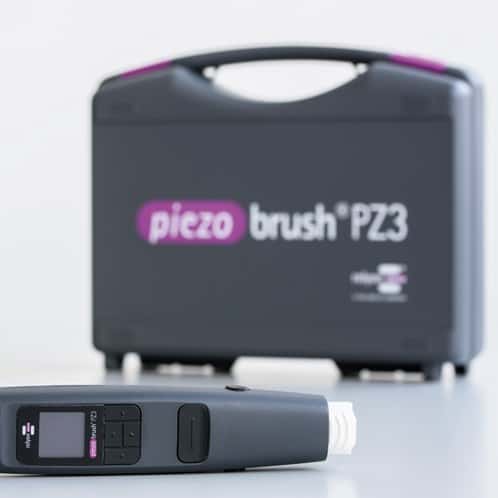
PiezoBrush PZ3
Effective plasma handheld device for manual use
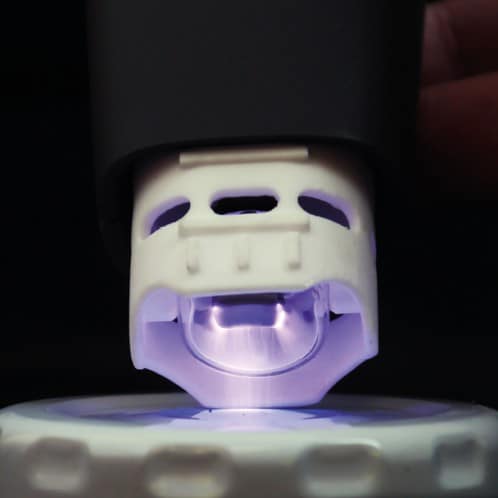
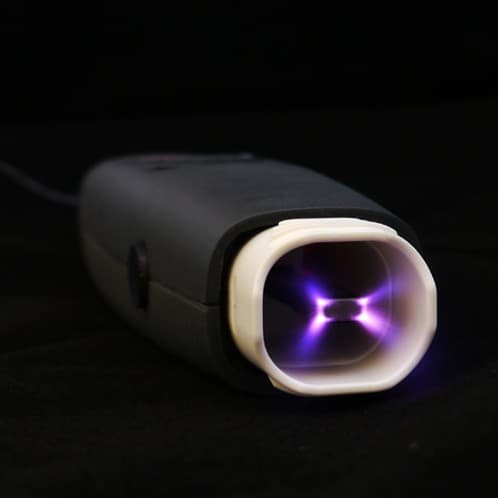
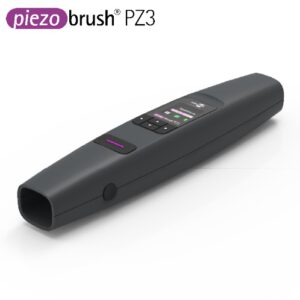
PiezoBrush PZ3 has been designed as a compact plasma handheld device for use in laboratories, predevelopment and assembly of small series. With a maximum power consumption of 18 W, the Piezoelectric Direct Discharge (PDD®) technology is used to generate cold active plasma at a low temperature. The heart of this portable plasma device is the TDK piezo plasma generator CeraPlas™ – a high-voltage discharge device for generating cold atmospheric-pressure plasma. Plasma is used to increase the surface energy of many materials with high efficiency, as well as to reduce germs and odors.
Fields of application
- Joining technology
- Development and optimization of production processes
- Research facilities and laboratories
- Microbiology, microfluidics and food technology
- Medical and dental technology
- Prototype and architectural model making
- Small-scale production
- Activation and functionalization of surfaces of various materials
- Improvement of wettability
- Optimization of bonding, painting, printing and coating processes
- Surface treatment of plastics, glass, ceramics, metals, semiconductors, natural fibres and composite materials
- Ultra-fine cleaning and odour reduction
Application examples
[su_posts template=”templates/default-loop-rp.php” posts_per_page=”3″ taxonomy=”post_tag” tax_term=”467″ order=”desc” ignore_sticky_posts=”yes” class_single=”.su-posts .su-post-title a; .su-posts .\.su-post-title”]
PiezoBrush PZ3 in the online shop
-
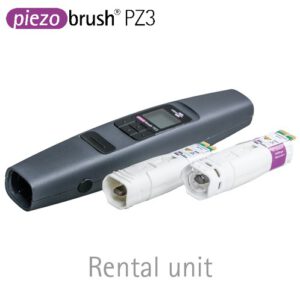
 Rental unit PiezoBrush PZ3400,00 € / 15 days
excl. 19% VAT
-
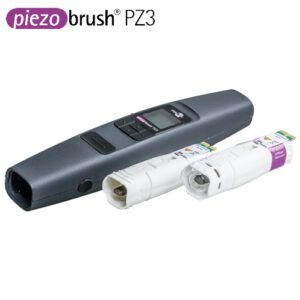
PiezoBrush PZ3 (without modules)1.620,00 €
excl. 19% VAT
-
PiezoBrush PZ3 Professional Set2.540,00 €
excl. 19% VAT
Technical details PiezoBrush PZ3
- Electrical connection: 110-240 V / 50-60 Hz
- Power consumption: max. 18 W
- Weight: 110 g
- Design: Handheld unit with plug-in power supply, integrated fan
- Sound pressure level: 45 dB
- Treatment speed: 5 cm²/s
- Typical treatment distance: 2 – 10 mm
- Typical treatment width: 5 – 29 mm
Modules
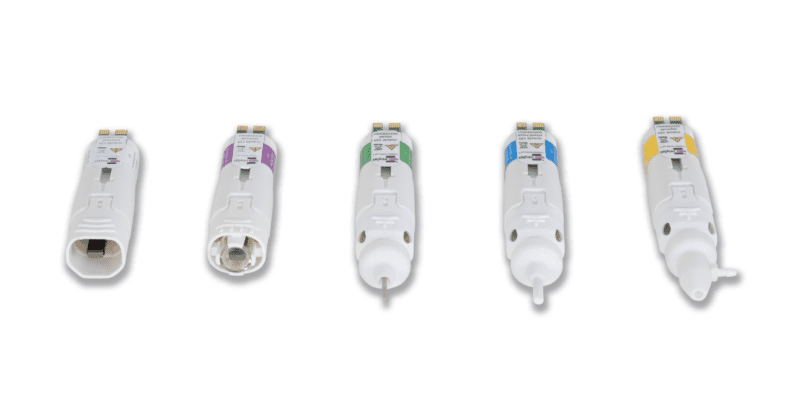
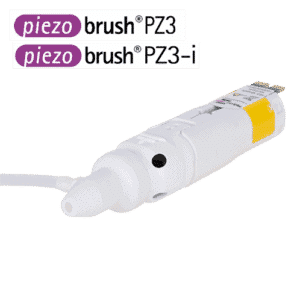
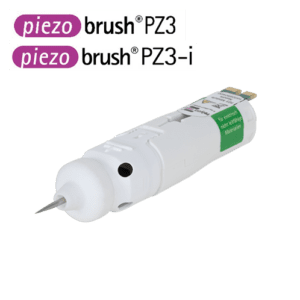
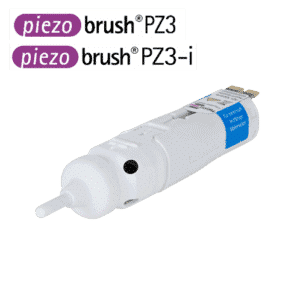
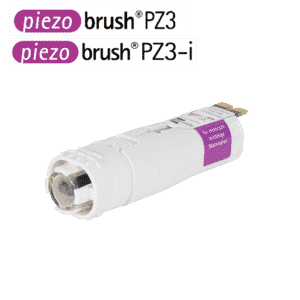
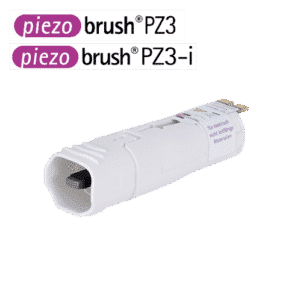
Different surfaces have to be activated with the appropriate accessories to achieve an ideal result. Currently five different modules are available for the PiezoBrush PZ3 plasma handheld device. The PDD technology used to generate the cold plasma in PiezoBrush PZ3 is based on the discharge of high electric fields. Therefore, the electrical conductivity of the component to be treated is of decisive importance when choosing the modules.
Modules in the online shop
Display
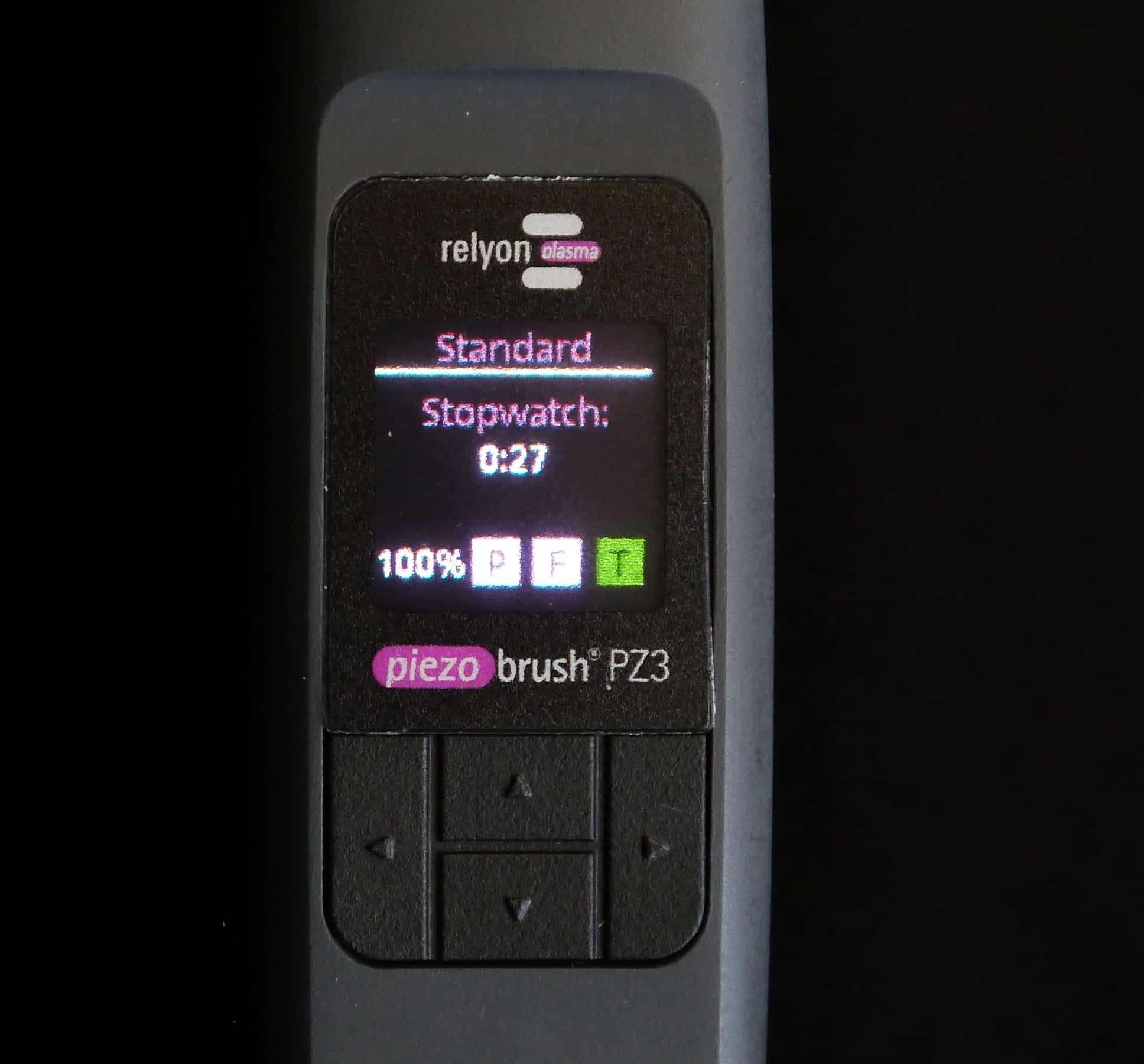
For process control of plasma treatment, the PiezoBrush PZ3 is equipped with various features that can be selected and modified via the display:
- Process control
– Stopwatch: For monitoring the treatment time
– Countdown: Time setting with automatic switch-off function
– Metronome: Acoustic feedback after defined treatment time - Power adjustment: Reduction of plasma power in several increments
Stand for PiezoBrush PZ3
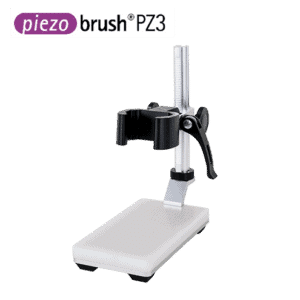
The stand has been designed for the PiezoBrush PZ3 to allow hands-free operation of the handheld device. The height and angle of the stand can be easily and quickly adjusted according to customer requirements. The rubber studs on the base of the stand ensure a secure footing.
Accurate and reproducible processing of substrates is possible with the stand. The included support plate enables the treatment of conductive and non-conductive substrates.
The stand consists of a frame, a clamping device for holding the PiezoBrush PZ3 and a lay-on plate. The stand and its components can be stored in the supplied case.
Fields of application:
- Laboratory
- Dental technology
- Small series
The dimensions of the stand are (W x H x D): 78 mm x 190 mm x 180 mm
FAQs
[su_accordion][su_spoiler title=”Is the PiezoBrush PZ3 a corona device?” open=”no” style=”h2″ anchor=”” class=””]No, the PiezoBrush is a jet with the advantages of more intensive treatment and less charge transfer.[/su_spoiler]
[/su_accordion]
[su_accordion][su_spoiler title=”Is it possible to feed in external gases?” open=”no” style=”h2″ anchor=”” class=””]JYes, the Multigas Module allows the use of other process gases such as nitrogen and the noble gases helium and argon.[/su_spoiler]
[/su_accordion]
[su_accordion][su_spoiler title=”How fast must the PiezoBrush be moved over the surface?” open=”no” style=”h2″ anchor=”” class=””]Depending on the application, a treatment speed of up to 20 mm/s is recommended.[/su_spoiler]
[/su_accordion]
[su_accordion][su_spoiler title=”How long does the activation effect last?” open=”no” style=”h2″ anchor=”” class=””]The decrease in time of plasma activation (hydrophobic recovery) varies greatly. It is based on three main influencing factors: the plasma treatment (e.g. selection of process gas and plasma solution), the nature of the treated substrate and the storage conditions (e.g. temperature, relative humidity). Accordingly, further processing should take place as soon as possible after plasma treatment.[/su_spoiler]
[/su_accordion]
[su_accordion][su_spoiler title=” Can I process a component for too long?” open=”no” style=”h2″ anchor=”” class=””]Due to the low temperature of the generated plasma, an overtreatment as it often occurs with conventional plasma systems due to thermal stress is not possible with most modules. Only with the needle module is there a higher concentrated temperature input.[/su_spoiler]
[/su_accordion]
[su_accordion][su_spoiler title=”What modules are available for the PiezoBrush?” open=”no” style=”h2″ anchor=”” class=””]There are currently five different exchangeable modules: the Standard, Nearfield, Needle, Nearfield Needle and Multigas Module. These are also suitable for the PiezoBrush PZ3-i.[/su_spoiler]
[/su_accordion]
[su_accordion][su_spoiler title=”Is there a holder for the hand-held unit for even treatment?” open=”no” style=”h2″ anchor=”” class=””]Yes, a stand is available as an accessory for the PiezoBrush PZ3. The device can be clamped in this to ensure uniform treatment of substrates. [/su_spoiler]
[/su_accordion]
[su_accordion][su_spoiler title=”How high is the ozone emission?” open=”no” style=”h2″ anchor=”” class=””]In air operation, the PiezoBrush generates ozone with a maximum concentration of 10ppm and a quantity of 25l/min. For continuous operation, an exhaust system with activated carbon filter is recommended.[/su_spoiler]
[/su_accordion]
[su_accordion][su_spoiler title=”Can the PiezoBrush cause a dangerous electric shock?” open=”no” style=”h2″ anchor=”” class=””]No, the amount of charge and the current strength that can be directly transmitted is too small.[/su_spoiler]
[/su_accordion]
[su_accordion][su_spoiler title=” Which materials can be processed?” open=”no” style=”h2″ anchor=”” class=””]In principle, all materials can be processed. With metals, care must be taken to avoid electric flashovers. With regard to working speed and effect, please refer to the application reports.[/su_spoiler]
[/su_accordion]
[su_accordion][su_spoiler title=”What is the optimum working distance?” open=”no” style=”h2″ anchor=”” class=””] For the Nearfield and Nearfield Needle Modules, the optimum working distance is 0.5 – 2 mm, for the Needle Module 2 – 5 mm, for the Standard Module 2 – 10 mm and for the Multigas Module 2 – 20 mm.[/su_spoiler]
[/su_accordion]
[su_accordion][su_spoiler title=”How much does the adhesion of my bonded area increase?” open=”no” style=”h2″ anchor=”” class=””]Adhesion strongly depends on the material and adhesive. Please read the application reports.[/su_spoiler]
[/su_accordion]
[su_accordion][su_spoiler title=”How can I make the activation effect visible?” open=”no” style=”h2″ anchor=”” class=””]In the simplest case, you will achieve good water wettability (72mN/m), which you can check with a simple water ink.[/su_spoiler]
[/su_accordion]
[su_accordion][su_spoiler title=”Can the PiezoBrush clean components?” open=”no” style=”h2″ anchor=”” class=””]Thin layers of release agent or adsorbates can be removed (fine cleaning). Thicker layers are not removed.[/su_spoiler]
[/su_accordion]
[su_accordion][su_spoiler title=”How often must the module insert be changed?” open=”no” style=”h2″ anchor=”” class=””]In normal operation, the module insert hardly wears out. However, depending on the working conditions, discoloration may occur after a few hundred hours of operation.[/su_spoiler]
[/su_accordion]
[su_accordion][su_spoiler title=”Does the PiezoBrush emit UV light?” open=”no” style=”h2″ anchor=”” class=””] The light emission of the PiezoBrush during air operation is very low and completely harmless.[/su_spoiler]
[/su_accordion]
[su_accordion][su_spoiler title=”Can the PiezoBrush damage the skin?” open=”no” style=”h2″ anchor=”” class=””] If the PiezoBrush is brought so close to the skin that an electric arc ignites, a local superficial burn may occur.[/su_spoiler]
[/su_accordion]
Downloads
| Description | Language | Download |
|---|---|---|
| Manual | ML | Manual |
| Flyer | EN | Flyer |
| Brochure | EN | Brochure |
| Comparison PiezoBrush PZ2 and PiezoBrush PZ3 | EN | Flyer |
| Whitepaper: Operation Principle and Characteristics | EN | Whitepaper |
| Whitepaper: Ozone control | EN | Whitepaper |
| Flyer – PiezoBrush PZ3 in the dental lab | EN | Flyer |
| Whitepaper PiezoBrush PZ3: endurance test for standard module | EN | Whitepaper |
| Aufbauanleitung PZ3 Stativ / Assembly instruction PZ3 stand | ML | Aufbauanleitung PZ3 Stativ / Assembly instruction PZ3 stand |