


Spaulding Classification
The Spaulding classification is an established system for categorizing medical instruments based on their associated infection risk: critical, semi‑critical, and non‑critical. It provides clear guidance for selecting appropriate cleaning, disinfection, and sterilization procedures. In doing so, it helps healthcare facilities ensure patient safety and maintain reliable hygiene standards. [1,2,3]
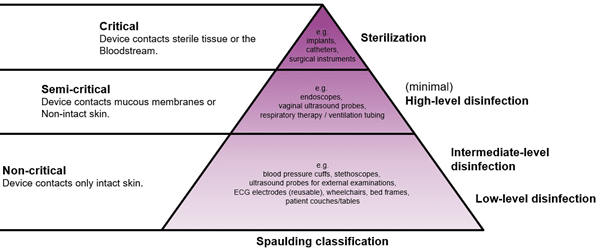
The differentiation between low‑level, intermediate‑level, and high‑level disinfection enables the precise selection of suitable reprocessing methods for medical devices. While low‑level disinfection is primarily effective against vegetative bacteria and certain viruses, intermediate‑level disinfection expands this spectrum to include mycobacteria and some resistant viruses. High‑level disinfection provides the highest degree of microbial reduction short of sterilization and inactivates nearly all microbial forms, including most bacterial spores, unless full sterilization is specifically required. [1,2,4]
[1] Rowan, N.J.; Kremer, T.; McDonnell, G. A review of Spaulding’s classification system for effective cleaning, disinfection and sterilization of reusable medical devices: Viewed through a modern-day lens that will inform and enable future sustainability. Sci. Total Environ. 2023, 878, 162976. https://doi.org/10.1016/j.scitotenv.2023.162976.
[2] Rutala, W.A.; Boyce, J.M.; Weber, D.W. Disinfection, sterilization and antisepsis: An overview. Am. J. Infect. Control 2023, 51, A3-A12. https://doi.org/10.1016/j.ajic.2023.01.001.
[3] Lee, Y.K.; Park, J.B. Steps of Reprocessing and Equipments. Clin. Endosc. 2013, 46, 274-279. https://doi.org/10.5946/ce.2013.46.3.274.
[4] McDonnel, G.; Burke, P. Disinfection: is it time to reconsider Spaulding? J. Hosp. Infect. 2011, 78, 163-170. https://doi.org/10.1016/j.jhin.2011.05.002.