

Disinfection
Disinfection refers to the process of reducing the number of pathogenic microorganisms to a level that no longer poses an infection risk. In the medical field, a reduction of at least 5 log₁₀ levels (99.999 %) is typically required, as described in standards such as DIN EN 14885 or DIN EN 13727. [1,2]
There are many methods of disinfection, with chemical disinfection being the most commonly used approach, for example wiping surfaces with alcohols or other disinfectants. However, toxicity and material compatibility can be critical concerns with these methods. In the reprocessing of medical devices, thermal disinfection procedures are well established. They are chemically safe but not suitable for materials that cannot withstand heat. Ultimately, the choice of method depends on the material to be treated, the type of contamination and the intended application. [1,2]
Plasma technology offers an innovative alternative, particularly for temperature-sensitive materials. Cold atmospheric pressure plasmas generate a mixture of reactive oxygen and nitrogen species, especially ozone and hydrogen peroxide, as well as UV radiation and electric fields, which together lead to rapid inactivation of microorganisms. Studies show that plasma can achieve bactericidal, fungicidal and in some cases even virucidal effects, depending on the system and exposure time, making it a promising disinfection method. [3,4]
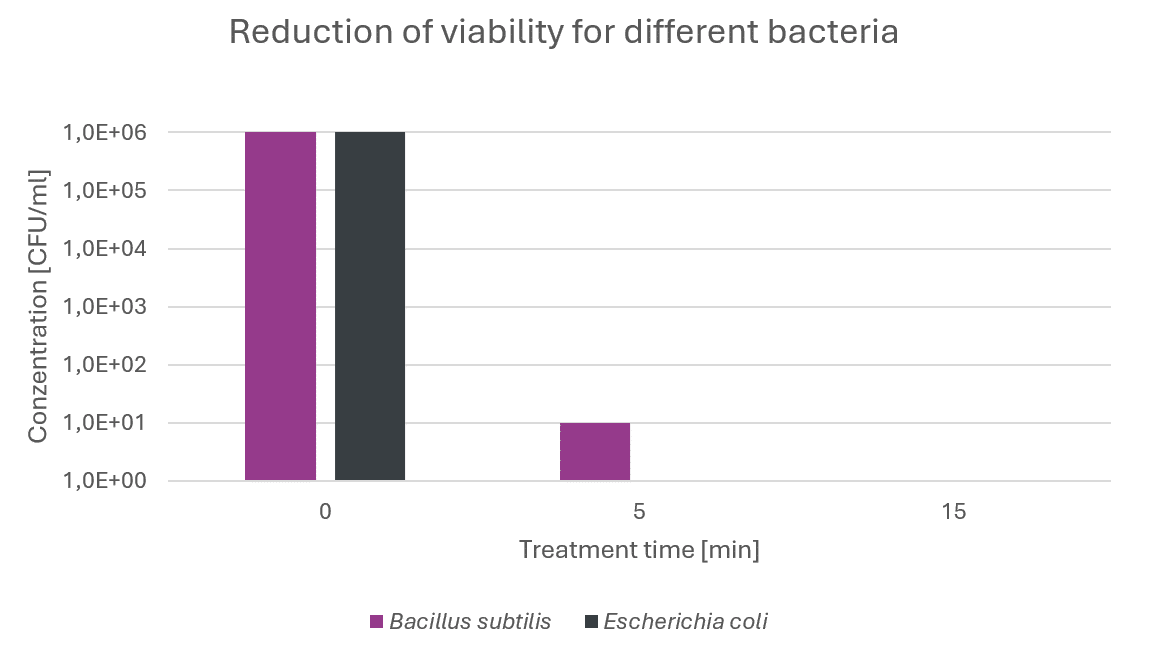
Here, the MediPlas represents an innovative disinfection solution. The system consists of the MediPlas Reactor and the MediPlas Driver. Using dielectric barrier discharge (DBD) technology, the reactor generates reactive compounds whose composition and concentration can be precisely controlled to meet the requirements of specific application fields. In experimental studies, the disinfection performance of the MediPlas was successfully demonstrated against various bacterial species, including Bacillus subtilis and Escherichia coli. These results indicate that the system can be applied as a high‑level disinfection technology within the medical and healthcare sectors.
[1] Costa, M.J.; Pastrana, L.M.; Teixeira, J.A.; Sillankorva, S.M.; Cerqueira, M.A. Bacteriophage Delivery Systems for Food Applications: Opportunities and Perspectives. Viruses 2023, 15, 1271. https://doi.org/10.3390/v15061271.
[2] Mohapatra, S. Sterilization and Disinfection. In Essentials of Neuroanesthesia 2017, 929-944. https://doi.org/10.1016/B978-0-12-805299-0.00059-2.
[3] O’Connor, N.; Cahill, O.; Daniels, S.; Galvin, S.; Humphreys, H. Cold atmospheric pressure plasma and decontamination. Can it contribute to preventing hospital-acquired infections? J. Hosp. Infect. 2014, 88, 59-65. https://doi.org/10.1016/j.jhin.2014.06.015.
[4] Zampieri, L.; Agus, R.; Myers, B.; Cavazzana, R.; Cordaro, L.; De Masi, G.; Zuin, M.; Riccardi, C.; Furno, I.; Martines, E. Multimodal Comparison of Cold Atmospheric Plasma Sources for Disinfection. Appl. Sci. 2025, 15, 7037. https://doi.org/10.3390/app15137037.