

Project PAPERLIGHT: Atmospheric Cold Plasma for Separating Mold-Induced Blocking in Historical Paper Documents.
New Approaches for Preserving Our Written Cultural Heritage.
Historical books, manuscripts, charters, and archival collections are an essential part of our cultural heritage. However, many of these unique documents are affected by microbial contamination resulting from moisture damage, flooding, or unsuitable storage conditions. Mold infestation is particularly problematic: it not only impairs the readability and usability of historical documents but can also permanently damage their material structure over time.
The research project PAPERLIGHT addresses a key challenge in modern conservation science: Can atmospheric cold plasma help gently separate mold-induced blockages in historical paper documents?
The project is funded by the German Federal Environmental Foundation (DBU) and is carried out jointly by the University of Applied Sciences and Arts Hildesheim/Holzminden/Göttingen (HAWK), Kiel University (CAU), and relyon plasma GmbH (Project Number: 40965/01).
When Paper Pages Grow Together
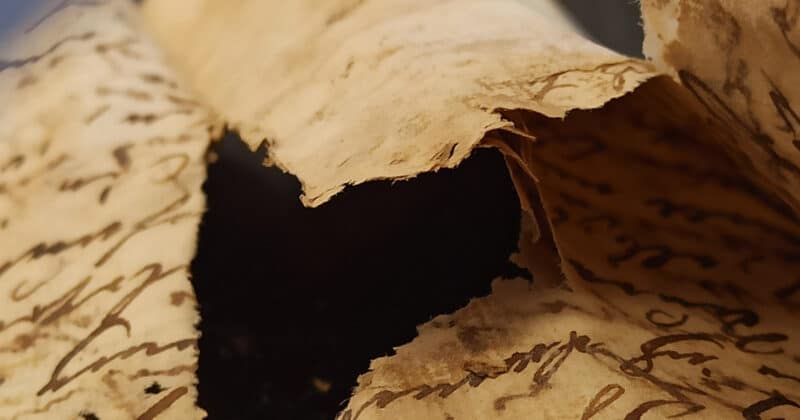
Mold damages paper in various ways. In addition to discoloration and staining, fungi produce enzymes that degrade components of the paper. At the same time, fungal mycelium penetrates deeply into the paper structure. Particularly after water damage or prolonged moisture exposure, this can create strong bonds between individual pages.
These so-called blockages are among the most challenging types of damage encountered in archives and libraries. In many cases, the affected pages can no longer be separated without causing further damage to the already weakened paper structure. Conservators therefore face the challenge of releasing these blockages without introducing additional harm to the cultural asset.
The relevance of this issue continues to grow. Extreme weather events, flooding, and climate-related changes increase the risk of moisture and mold damage in archives, libraries, and collections. At the same time, there is a growing demand for sustainable and material-friendly conservation methods.
Limitations of Established Treatment Methods
Various methods are available for treating microbially damaged documents. Mechanical cleaning methods can quickly reach their limits when dealing with severely damaged papers. Chemical or aqueous treatments are also not always suitable, as they may affect inks or cause further alterations to the material.
Established decontamination methods such as ozone treatments, biocides, or gamma irradiation also have limitations. Besides their potential impact on materials, environmental and occupational safety considerations play an important role. In particular, gamma irradiation generally requires transporting affected objects to specialized facilities. Atmospheric cold plasma systems, by contrast, could potentially be used directly on-site in archives, libraries, or conservation workshops in the future.
A New Approach to Solving Mold-Induced Blockages
While previous research has often focused on the antimicrobial effects of plasma, PAPERLIGHT pursues a broader approach. The project is not exclusively concerned with eliminating microorganisms but rather with the targeted separation of paper pages bonded together as a result of mold growth.
To achieve this, plasma jets are used to direct plasma locally and precisely onto affected areas. The desired effect results from the interaction of various plasma components and physicochemical processes. Reactive species can attack biological residues while localized surface modifications and ablation processes occur simultaneously.
The goal is to enable the separation of mold-induced connections between paper pages while preserving the historical material as effectively as possible.
Scientific Foundations and Initial Findings
An important foundation of the project is the scientific study Cleaning books with light? Plasma treatment on mould infested paper (Nithack & Messal, 2026). This study analyzed the effects of various atmospheric plasma treatments on mold-infested paper.
The results showed that plasma treatments can visibly remove mold residues from paper surfaces. The study also examined how different plasma types, as well as ozone and UV-C treatments, affect paper structure. The findings indicated that plasma can achieve more effective mold removal than ozone or UV-C treatment alone. At the same time, the study highlighted the importance of carefully evaluating effects on paper fibers and defining appropriate treatment parameters.
These findings provide the scientific basis for the ongoing investigations within the PAPERLIGHT project. The project builds, among other things, on the research of Friederike Johanna Nithack and Prof. Dr. Constanze Messal on plasma treatment of mold-infested paper and further develops these approaches specifically for the separation of mold-induced blockages in historical documents.
The Role of the Project Partners
The scientific coordination of the project is carried out by the HAWK University of Applied Sciences and Arts. Here, conservation science, microbiology, and materials science expertise are brought together.
Kiel University investigates the physical and chemical properties of the plasma sources used. The focus is on characterizing reactive species generated within the plasma, such as oxygen and nitrogen species, and studying their interaction with mold residues and paper fibers. The objective is to identify the plasma components and mechanisms that contribute to releasing mold-induced blockages while minimizing stress on historical paper.
relyon plasma GmbH contributes its extensive experience in the development of atmospheric plasma systems to the project. Among the systems used are the PiezoBrush PZ3 and PiezoBrush PZ3-i, which can be flexibly adapted to different research tasks through various modules and process gas options. In addition, relyon plasma is investigating the technical feasibility of future device and application concepts for conservation-related use cases.
From Feasibility Study to Practical Application
The project aims to establish the technical and scientific foundations required for the future use of cold plasma in conservation. To achieve this, suitable plasma sources, process gases, and treatment parameters are being investigated. Modern analytical methods are also employed to evaluate changes in paper, mold structures, and surfaces in detail.
In the long term, this work could lead to the development of a specialized tool that supports conservators in treating severely damaged historical documents. The technology has the potential to reduce the use of chemical agents and open new possibilities for preserving mold-damaged cultural heritage.
Significance for Cultural Heritage Preservation
If successful, PAPERLIGHT could make a significant contribution to the preservation of historical paper collections. The project combines conservation requirements with modern plasma technology and explores a previously under-researched application area of atmospheric cold plasma.
The insights gained may eventually extend beyond historical books and archival materials. Other sensitive cultural heritage objects affected by microbial damage could also benefit from the methods developed within the project.
In this way, PAPERLIGHT contributes to the development of innovative and sustainable technologies for protecting our cultural heritage.
Further Information
Project Funding
- German Federal Environmental Foundation (DBU), PAPERLIGHT Project (Grant Number 40965/01)
Methods development for the application of atmospheric cold plasma in the separation of mold-induced blockages in paper documents
https://www.dbu.de/projektdatenbank/40965-01/ [dbu.de]
Project Partners
- HAWK University of Applied Sciences and Arts Hildesheim/Holzminden/Göttingen
https://www.hawk.de - Kiel University, Institute of Experimental Physics
https://www.physik.uni-kiel.de - relyon plasma GmbH
https://www.relyon-plasma.com
Scientific Publication
- Nithack, F. J., & Messal, C. (2026). Cleaning books with light? Plasma treatment on mould infested paper. Conservar Património.
https://doi.org/10.14568/cp39266