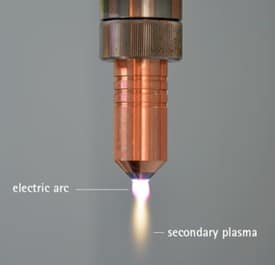


Primary and secondary Plasma
Primary Plasma
Primary plasma refers to the region of a plasma that is located at the core of the discharge (in the image, this corresponds to the electric arc). In this zone, the electrical or electromagnetic energy supplied by an external source is directly coupled into the process gas. This is where the characteristic plasma-specific conditions arise, including high ionization rates, elevated electron density and a significantly increased electron temperature. In primary plasma, the electron temperature is considerably higher than the temperature of ions and neutral particles. As a result, many technical applications operate with a non-equilibrium plasma in which the electrons carry a large amount of energy while the bulk gas remains comparatively cool.
Primary plasma is dominated by highly energetic electrons that are strongly accelerated by the applied field. These electrons collide with neutral gas atoms or molecules and trigger a wide range of processes, including impact ionization, excitation and dissociation. The outcome is a highly activated gas mixture composed of ions, electrons, radicals and metastable species. This region is usually spatially well-defined and represents the most reactive part of the entire plasma system.
Secondary Plasma
Secondary plasma is used when ionization and activation no longer result from direct energy input, but instead from subsequent processes initiated by the primary plasma. Secondary plasma, sometimes referred to as plasma gas, describes the neutral and semi-stable gas particles that are formed during a plasma discharge through recombination. Because this region is no longer directly coupled to the energy source, electrons and ions gradually lose energy through collisions and recombination. Consequently, both the electron density and the electron temperature decrease significantly. In this zone, slow secondary electrons, metastable species and photons dominate. They carry much less energy than the highly accelerated electrons in the primary region, which is why secondary plasma is energetically cooler and more diffuse. This state is not considered plasma, but rather a gas mixture, which is why it is called secondary plasma.