

Oxide reduction
In ambient air, most metals are covered by a native oxide film. For many technological treatments, it is disturbing, and measures are undertaken to remove it. The task of plasma-based surface oxide reduction is to convert the oxide into the underlying metal. Typically, the hydrogen-containing gases are used for this purpose. The ability of hydrogen to reduce oxides has long been known. Following his 1766 discovery of hydrogen, Henry Cavendish demonstrated that it reacts with metal oxides to produce water and metal. Important for successful reduction is the diffusion of the reducing gas into the oxide layer. The elevated temperature enhances diffusion, thereby speeding up the reduction [1]. The PAA-based plasma tools are very promising for reduction due to the existing chemical and thermal process components.
Oxides of many different metals, such as silver, copper, aluminum, iron alloys, or titanium, can be reduced [2]. A typical example is the treatment of copper electrodes on electronic plates or lead frames to improve solderability [3].
The reduction of copper or silver oxide under ambient air conditions is prone to back oxidation because both the reduction and oxidation reactions accelerate with temperature. To avoid it, an artificial ambient with very low oxygen content is frequently used. It can be realized by a nitrogen-filled tunnel. But a treatment in a hermetically closed chamber can be considered.
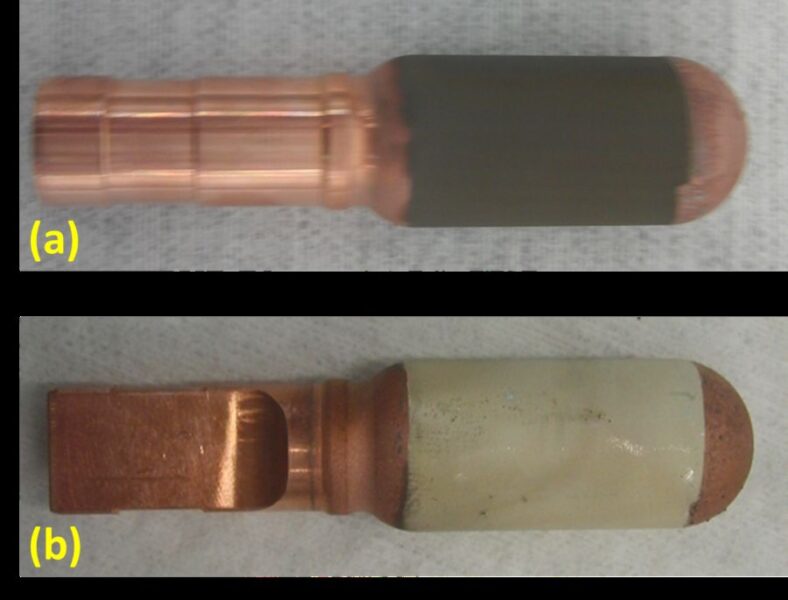
Figure: The high-voltage contact fingers, silver-coated by LTPS (a) directly after coating and (b) after oxide reduction. The plasma treatment was conducted using PB3 at 55 mbar, with a gas mixture of 95% nitrogen and 5% hydrogen at a flow rate of 55 SLM, a pumping speed of 105 m3 h−1, and a treatment time of 40 s.
References
[1] Sabat, K.C.; Paramguru, R.K.; Mishra, B.K. Reduction of copper oxide by low-temperature hydrogen plasma. Plasma Chem Plasma Process 2016, 36, 1111 – 1124. https://doi.org/10.1007/s11090-016-9710-9. [2] El Khalloufi, M.; Soucy, G. Oxide reduction treatment with a thermal plasma torch: A case study. Minerals 2024, 14, 443. https://doi.org/10.3390/min14050443. [3] Korzec, D.; Hoffmann, M.; Nettesheim, S. Application of plasma bridge for grounding of conductive substrates treated by transferred pulsed atmospheric arc. Plasma 2023, 6, 139 – 161. https://doi.org/10.3390/plasma6010012.